

Introduction
Companion Document: This implementation guide builds on the concepts and benefits described in “Dynamic Ephemeral Credentials: The Gold Standard of Modern Machine IAM.”
Transforming from static credential chaos to an ephemeral-first architecture requires strategic planning, organizational alignment, and systematic execution. This guide provides a roadmap for that transition: where to start, how to overcome common obstacles, and how to build momentum toward the gold standard.
Starting Points That Work
Successful adoption begins with strategic choices about where to implement first:
New microservices and cloud-native applications represent the path of least resistance. These greenfield projects haven’t accumulated technical debt and can adopt modern patterns from day one. Teams building new services should face a simple requirement: use dynamic ephemeral credentials or provide compelling justification for an exception.
Internal service-to-service communication offers high-value wins with manageable scope. Services within your infrastructure already share network boundaries and trust assumptions. Implementing service mesh authentication or SPIFFE identities for internal APIs eliminates entire categories of credentials while improving security and observability.
API gateway authentication provides a natural choke point for modernization. Rather than distributing API keys to every client, workloads present dynamically-issued credentials to the gateway. The gateway validates credentials and enforces access policies, creating a secure perimeter without requiring changes to backend services.
Database access modernization yields immediate security benefits when database systems support modern authentication methods. Instead of storing database passwords in configuration files or environment variables, applications can use ephemeral credentials through several approaches: platform-managed identities that support database authentication (when the database supports this), SPIFFE Verified Identity Documents (SVIDs), short-lived passwords generated by secrets managers, or certificate-based authentication (for databases that accept X.509 certificates). The key requirement is that the target database must support at least one of these modern authentication mechanisms.
The pattern is consistent: start where resistance is lowest, and value is highest, demonstrate success, and expand systematically.
Why Organizations Miss the Gold Standard (And the Real Cost)
Despite clear advantages, most organizations continue creating static credentials. Understanding why reveals how to overcome the barriers.
Common Obstacles
To understand why static credentials persist, we can group the primary obstacles into two categories:
The Human Factor
- Knowledge Gaps: Many developers, DevOps engineers, and security professionals are unaware that ephemeral credentials are a viable option. They default to familiar patterns—like API keys—simply because that is what they learned, what their frameworks prioritize, and what standard documentation reflects.
- Perceived Complexity: While API keys are viewed as “simple” strings to paste into configurations, modern alternatives like OAuth flows or platform-managed identities appear daunting. When under pressure to ship features, teams often avoid the learning curve associated with these new patterns.
The Structural Factor
- Short-Term Pressure: Product deadlines drive short-sighted decisions. When infrastructure for ephemeral credentials doesn’t exist, teams opt for the immediate solution (the API key) with the intention of fixing it later—a “later” that rarely arrives, compounding technical debt.
- Organizational Disconnects: The teams creating machine identities (developers/DevOps) often operate independently from the teams managing the resulting security risks (IAM/Security). Decisions are made to optimize for deployment speed, leaving security teams to manage the fallout of scattered, unowned credentials.
- Legacy Constraints: Organizations with entrenched infrastructure often face genuine blockers, such as database systems or third-party APIs that only support static credentials. This can lead to the fatalistic conclusion that if not all credentials can be eliminated, none should be.
- The Velocity of Agentic Workloads: Agentic AI systems operate with higher autonomy and velocity than traditional microservices. Agents must not hold static or long-lived keys because they could leak them or elevate privileges in unexpected situations.
The True Cost of Settling for Less
The decision, or inertia, that leads to continue using static credentials carries costs that compound over time:
- Security incidents wait in the wings. Non-human identities are a primary target for attackers, with millions of secrets leaked annually and breaches costing an average of $4.44 million.
- Operational burden grows unsustainably. Credential coordination complexity multiplies exponentially with the number of services, turning simple rotation schedules into unmanageable nightmares.
- Competitive disadvantages emerge. Every hour spent manually managing static credentials is an hour stolen from innovation, leaving teams unable to keep pace with agile competitors who leverage automated, ephemeral-first patterns.
The Required Mindset Shift
Transforming from static credential chaos to an ephemeral gold standard requires fundamental changes in thinking:
From “credential management” to “trust establishment.” The goal isn’t managing credentials better; it’s eliminating the need to manage them at all. Instead of asking “How do we securely store and rotate this API key?” the question becomes “How do we enable this workload to prove its identity automatically?” This shift moves organizations toward what many call “secretless” or “credentialless” architectures, where workloads authenticate based on cryptographic identity rather than stored secrets.
From “secrets as configuration” to “identity as infrastructure.” Credentials shouldn’t be configuration items that teams manually provision and track. Identity should be a foundational infrastructure that the platform provides automatically, much like networking or storage.
From “set and forget” to “automatic and ephemeral.” The appeal of static credentials is their apparent simplicity: set them once, and they work indefinitely. This perceived advantage is actually the vulnerability. Automatic, short-lived credentials require initial setup but eliminate ongoing maintenance while dramatically improving security.
From “Service Identity” to “Agentic Identity”: While service-to-service communication relies on defined, stable patterns, agentic communication is evolving, ephemeral, and intent-based. Organizations must shift toward high-trust, context-aware identities that carry the agent identity (the actor) as well as the identity of a human user (the subject, when applicable) for audit purposes. A common anti-pattern is having agents simply authenticating as the identity of the service.
A critical insight drives successful transformation: You can’t tell teams to stop using static credentials until you provide better alternatives. Mandates without enablement breed frustration and shadow IT. The path forward requires building infrastructure, creating guidance, providing training, and making ephemeral credentials the path of least resistance.
The Roadmap: Navigating Toward the Gold Standard
Achieving the gold standard of dynamic ephemeral credentials requires strategic planning and systematic execution across five key phases.
Strategic Principles
Four principles guide successful transformation:
Principle 1: Start with the end in mind. Articulate what “ephemeral-first” means for your organization. This vision should inform every machine identity decision. Create a clear strategy focused on preventing new static credentials rather than merely managing existing ones. Establish metrics that measure progress toward dynamic patterns—not just reducing NHI count, but increasing the percentage of new workloads using ephemeral credentials. When teams understand the target architecture, they make better decisions even before formal processes enforce them.
Principle 2: Make the right path the easy path. Organizations succeed when adopting ephemeral credentials becomes easier than using API keys. This requires investment in three areas: infrastructure (deploy OAuth servers, SPIFFE/SPIRE, API gateways configured for modern authentication, service mesh capabilities), guidance (create reference architectures, code samples in every language your teams use, decision trees that guide teams to the right pattern for each use case), and support (establish champions who can help teams implement correctly and provide a clear point of contact for questions). When developers ask “How do I securely connect to this API?” they should receive a clear, simple answer that leads them to ephemeral credentials.
Principle 3: Progressive adoption, not perfection. Don’t attempt to boil the ocean. Mandate ephemeral credentials for all new development while taking a risk-based approach to legacy migration. Focus energy on high-value, high-risk systems rather than trying to migrate everything simultaneously. Accept that some residual legacy will persist; this is pragmatic, not a failure. The goal is to stop the creation of new technical debt while systematically addressing the most important existing debt.
Principle 4: Assemble your Swiss Army Knife. No single technology solves every use case. Success requires combining approaches strategically: service meshes excel at internal service-to-service communication, platform-managed identities work brilliantly within cloud boundaries, SPIFFE provides universal identity across platforms and clouds, and OAuth/OIDC patterns enable secure API authentication. Teams need guidance on which tool fits which scenario, not a mandate to use one approach for everything.
Practical Implementation Phases
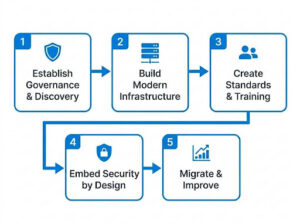
Phase 1: Establish Governance & Discovery
Transformation begins with coordination and visibility. Form a Machine IAM Working Group bringing together all stakeholders: IAM, Security, Engineering, DevOps, Infrastructure, Cloud, and Application teams. If your organization uses IoT or industrial control systems, include those teams as well. This cross-functional group needs executive sponsorship, clear decision rights, and a mandate for organizational change.
The working group’s first task is understanding the current state: Why do teams create static credentials? What workloads exist? What drives credential creation? Interview stakeholders to understand their needs before attempting to change their behavior. Many teams create API keys because they don’t know alternatives exist, or because alternatives aren’t available yet.
Simultaneously, build a comprehensive NHI inventory using discovery tools or workload identity management platforms. This inventory isn’t about immediately fixing everything—it’s about understanding the scope of technical debt and identifying the highest risks. Assign human ownership to every NHI discovered. When credentials lack clear owners, they become immortal.
Agent Inventory: In your discovery phase, explicitly identify and classify agents within your environment. Since agents can spin up and down rapidly, and chain from one to another, your inventory strategy must specifically account for ephemeral or non-persistent workloads to prevent “ghost” agent identities from becoming a security blind spot.
Phase 2: Build Modern Infrastructure
You can’t tell people to stop using static credentials until better alternatives exist. This phase assembles the toolset for ephemeral credentials—what I call the “Swiss Army Knife” of Machine IAM.
Many organizations already have components deployed piecemeal—different teams using various API gateways, OAuth libraries for specific projects, PKI infrastructure serving particular use cases. The challenge isn’t always implementing new technology but establishing coherent standards for existing deployments.
Core components to standardize or implement include: OAuth 2.0 stack (whether centralized or federated, with consistent implementation patterns), SPIFFE/SPIRE for bootstrapping workload identities without static credentials, API gateways with standard authentication and authorization patterns, policy engines like OPA, Cedar, or AuthZEN for consistent policy language across teams, PKI infrastructure focused on dynamic ephemeral certificates, service meshes providing consistent security boundaries, secrets management with common governance where dynamic approaches aren’t yet feasible, and comprehensive observability ensuring every interaction can be traced.
The working group must decide which capabilities to centralize (one platform for all) versus federate (multiple platforms with common standards). Both approaches work, but the decision must be explicit, and standards must be enforced.
Phase 3: Create Standards & Training
Tools without guidance create chaos, and guidance without training ensures failure. This phase develops comprehensive standards while educating teams on both the risks of static credentials and the benefits of dynamic patterns.
Essential documentation includes: reference architectures for common patterns, decision trees guiding teams from requirement to implementation (“If you need X, use tool Y with pattern Z”), sample code for each supported language and framework, integration standards for distributed tool deployments, migration guides from static to dynamic patterns, clear policies on acceptable versus prohibited practices, and documented processes for considering rare exceptions.
Education requires a multi-tiered approach: executive briefings on risk and compliance implications, hands-on workshops for developers and DevOps teams, architecture reviews incorporating machine identity patterns, success story socialization from early adopters, and clear communication about upcoming mandates. Focus on making the right path the easy path—if your guidance requires a PhD in cryptography, teams will continue using API keys.
Crucially, establish a clear point of contact for questions. Picture an infrastructure engineer needing database access for a nightly batch job. They need secure credentials and don’t have a safe place to store them. They ask around: “How can I do this right?” Make sure they know where to ask and will get a helpful answer.
Phase 4: Embed Security by Design
With dynamic patterns available, guidance documented, and teams trained, implement mandatory controls requiring these patterns for all new deployments.
The time has come to stop creating new static credentials. The alternatives exist in your environment—teams just need to learn and apply modern dynamic patterns.
Implement approval gates in CI/CD pipelines that detect static credentials. Mandate security review for any exceptions. Conduct regular audits of new repositories and deployments. Block deployments that violate policy without a valid justification.
Start with new projects where resistance is lowest, then expand to existing systems during updates. This isn’t punitive—it’s establishing the gold standard as the organizational norm.
Phase 5: Migrate & Improve
With new credential creation stopped, systematically address existing technical debt using a risk-based approach while establishing metrics and continuous improvement processes.
Several migration strategies apply to different scenarios:
Direct migration works for systems easily adapted to modern patterns. Applications using standard frameworks often require minimal changes to switch from API keys to OAuth or platform-managed identities.
Service mesh wrapping creates secure perimeters around legacy systems that can’t be easily modified. The mesh handles modern authentication externally while the legacy application continues using its existing patterns internally.
Credentialless brokers sit between workloads and services, injecting credentials on-the-fly. This proves valuable when workloads would otherwise need to store credentials but can’t easily adopt modern patterns.
Acceptance recognizes that some static credentials will persist indefinitely. Don’t aim for perfection—aim for “no new technical debt.” Legacy will always exist, but it doesn’t have to define your future.
Use a “migration factory” approach: standardize patterns, batch similar systems, and aim for 15-20% migration per quarter rather than attempting everything simultaneously. Monitor progress toward dynamic patterns, conduct quarterly working group reviews, update policies based on lessons learned, and provide continuous training as new team members join.
Comparing Approaches to the Gold Standard
Understanding where different approaches fall on the spectrum from static to ephemeral helps guide decisions:
| Approach | Security Posture | Operational Effort |
| Static credentials with good management | High Risk | High (manual maintenence/rotation) |
| Longer-lived dynamic credentials | Moderate Risk | Moderate (stepping stone during migration) |
| The ephemeral gold standard | Low Risk | Low (automated/secretless) |
Critical Success Factors & Call to Action
Achieving the gold standard requires more than technical implementation—it demands organizational commitment and sustained leadership.
What’s Required for Success
Executive sponsorship proves essential. Without C-level support, Machine IAM initiatives fail. Security leaders must articulate business risk and value in terms executives understand: This transformation prevents breaches costing millions, eliminates weeks of incident response time, and reduces operational overhead. The investment pays for itself in avoided breaches and faster deployments.
Frame it this way: “We have 45 machine credentials for every employee. Each one is extremely difficult to secure. Hackers target them aggressively, and many identity breaches involve these credentials. Each breach costs $4.44 million on average. This isn’t a technical problem—it’s a business risk requiring executive leadership to solve.”
Cross-functional collaboration transforms liability into strength. Who’s responsible for machine identity? Here’s the brutal truth: it’s everyone’s job, which means it’s nobody’s job. The Machine IAM Working Group coordinates action across organizational boundaries, ensuring IAM, Security, DevOps, Infrastructure, and Application teams work together rather than at cross-purposes.
Investment reality must be acknowledged upfront. Machine IAM requires significant resources: small-medium organizations should budget $100K-$500K over 6-12 months, mid-market enterprises $500K-$2M over 12-18 months, and large enterprises $1M-$10M+ over 18-36 months. This includes tools, professional services, training, and operational costs. Attempting transformation without adequate resources guarantees failure.
Pragmatic expectations keep teams motivated. Perfect security is a myth. Focus on continuous improvement: the real win isn’t cleaning up everything you have—it’s stopping the creation of new technical debt. Every new workload deployed with ephemeral credentials is a victory. Accept that residual legacy will persist while ensuring it doesn’t grow.
Role-Specific Actions
For security leaders: Make ephemeral credentials your stated organizational standard. Invest in infrastructure and training to enable adoption. Measure and report on progress toward dynamic patterns. Articulate the risks of legacy methods and the long-term security, compliance, and agility benefits of the gold standard. Collaborate broadly with DevOps, engineering, and platform teams—Machine IAM is a shared responsibility. Define clear ownership within your IAM team to prevent machine identity from becoming a neglected blind spot.
For development teams: Challenge the default of static credentials. Learn and implement modern authentication patterns through training, experimentation, and consulting with champions. Become advocates for ephemeral-first approaches by sharing successes and helping peers adopt these patterns. When starting new projects, default to dynamic ephemeral credentials unless specific constraints dictate otherwise.
For IAM teams: Expand expertise beyond human identity to include OAuth, SPIFFE, JWT, X.509, and other machine IAM technologies. Build or acquire capabilities for dynamic machine identity. Lead the transformation rather than being bypassed by other teams who step in to fill the gap. Partner closely with DevOps, engineering, and platform teams. Assign formal accountability for machine identity within your team.
The Fundamental Question
Every organization faces a choice with every new workload deployed: “Are we building toward ephemeral credentials as our gold standard, or are we managing the legacy we’re creating today?”
Every new service is a decision point. Every new API integration. Every new database connection. The choice is binary: static or dynamic. The cumulative effect of these choices determines whether your organization operates with increasing technical debt or increasing security and agility.
Conclusion: The Gold Standard as Guiding Principle
The harsh reality: most organizations carry significant static credential debt accumulated over years or decades. Acknowledging this debt without being paralyzed by it is the first step toward transformation.
The inspiring vision: dynamic ephemeral credentials represent fundamentally superior architecture. They eliminate entire categories of vulnerabilities, remove operational burden, enable true least privilege, and provide comprehensive audit trails. Organizations that master these patterns operate with greater security, agility, and efficiency than those managing static credential chaos.
The decisive action required: every decision should move toward or away from the gold standard. Even when you can’t implement ephemeral credentials immediately, you can choose not to create new static credentials. You can prioritize high-value migrations. You can build infrastructure and train teams. Progress compounds.
The AI imperative makes this transformation urgent. The explosion of machine identities driven by AI agents, automated processes, and intelligent systems creates a scale that humans cannot manage manually. Static credentials simply won’t work in this future. Organizations must master dynamic identity now or face overwhelming technical debt as AI proliferates.
The final message: The gold standard of dynamic ephemeral credentials exists, proven in production by organizations across industries and scales. The technologies are mature. The patterns are documented. The benefits are measurable.
The question isn’t whether ephemeral credentials represent superior architecture—they objectively do. The question is how quickly your organization moves toward this gold standard. Every day of delay creates more technical debt, more security risk, and more future migration work.
Start today. Form that working group. Deploy that infrastructure. Train those teams. Mandate ephemeral-first for new development. Begin strategic migration of legacy systems. The gold standard awaits. The only question is how long you’ll accept anything less.
Appendix: Quick Start Guide
5-Step Quick Start
Ready to begin moving toward ephemeral credentials? Start here:
- Form your working group – Bring together IAM, Security, DevOps, Infrastructure, and Application teams with executive sponsorship
- Pick one new project – Require the next new microservice to use platform-managed identities or SPIFFE instead of API keys
- Document the win – Track deployment time, developer experience, and security posture improvements
- Create a reference – Turn that successful implementation into a template others can follow
- Expand the mandate – Require ephemeral credentials for all new development, with exceptions requiring security approval
Remember: You don’t need to fix everything to start. You just need to stop making the problem worse while demonstrating that better alternatives work.
The Bootstrap Problem Solved
The Traditional Chicken-and-Egg:
- Application needs credentials to access services
- But how does it get the first credential securely?
- Common “solutions” just push the problem elsewhere:
- Store credentials in vault (but how to authenticate to vault?)
- Use environment variables (but who populates them?)
- Embed in container image (back to hardcoded secrets)
The Ephemeral Solution: Your infrastructure already knows:
- What workload is running
- Where it’s running
- How it was started
- What it should be allowed to do
Platform attestation leverages this knowledge:
- Workload starts and requests identity
- Platform verifies using information that only legitimate workloads have
- Platform issues cryptographically signed credentials
- Workload uses credentials to authenticate
- Credential expires automatically and renews if the workload is still valid
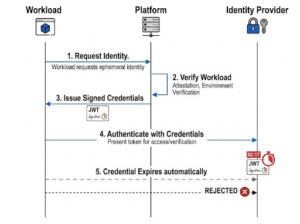
No pre-distributed secrets required. The chicken-and-egg problem simply disappears.
Myth Busted: “Ephemeral Credentials Are Too Complex”
The Myth: “Ephemeral credentials require PhD-level cryptography knowledge and massive infrastructure investment. API keys are just simpler.”
The Reality: Modern platforms make ephemeral credentials easier than credential management:
With API keys, you must:
- Generate and securely store credentials
- Distribute them to applications safely
- Implement rotation schedules
- Track which apps use which keys
- Revoke and replace when leaked
With ephemeral credentials, you:
- Configure platform identity (one-time setup)
- Let workloads authenticate automatically
- No rotation needed (automatic)
- Clear identity per workload
- Credentials expire automatically
- Comprehensive audit logs provided
The Truth: Initial setup requires learning, but ongoing operations are dramatically simpler. The “complexity” is one-time architectural work that eliminates endless operational complexity.
References
Breach Statistics and Costs:
GitGuardian. (2025). State of Secrets Sprawl Report 2025. Retrieved from
https://www.gitguardian.com/state-of-secrets-sprawl-report-2025
IBM Security. (2025). Cost of a Data Breach Report 2025. Retrieved from
https://www.ibm.com/reports/data-breach
Notable 2024 Breaches:
Dark Reading. (2025). Cloudflare Falls Victim to Okta Breach, Atlassian Systems Cracked. Retrieved from
Techcrunch. (2024). How a mistakenly published password exposed Mercedes-Benz source code. Retrieved from
https://techcrunch.com/2024/01/26/mercedez-benz-token-exposed-source-code-github/
Felix Gaehtgens the VP, Product Strategy for member company BeyondTrust, and is an active member of the IDSA Machine and Agentic Identity Working Group. To learn more about membership and participating in the working group, email memben@idsalliance.org.