

Introduction: Knowing Better, But Not Doing Better
Every security professional knows that hardcoded API keys are dangerous. Every IAM leader understands that static credentials pose significant risks. Every developer has heard the warnings about credential leakage. Yet despite this universal knowledge, organizations continue creating static credentials—API keys, service account passwords, personal access tokens—at an astonishing rate.
Now these static credentials find their way into AI agents – trusting agents to keep them safe. As organizations increasingly deploy agentic AI systems with autonomous access to APIs, data stores, and operational workflows, the risks associated with static credentials multiply dramatically.
The statistics tell a stark story: 23.77 million new secrets were leaked on GitHub in 2024 alone, representing a 25% surge from the previous year 1. Identity-related breaches cost organizations an average of $4.44 million globally 2. Real-world incidents from across the globe underscore the danger: Cloudflare had to rotate over 5,000 credentials and perform forensic analysis on nearly 5,000 systems after a breach stemming from inadequate credential management 3. Mercedes-Benz exposed source code after a personal access token (PAT) from one of its developers was leaked 4. Thousands of Adobe Commerce stores worldwide were compromised using stolen cryptographic keys5.
The gap between knowing and doing reveals a fundamental problem: most organizations approach machine identity as a credential management challenge rather than recognizing it requires an architectural transformation. They invest in secrets vaults, implement rotation schedules, deploy scanning and “NHI Management” tools—all worthy efforts that treat symptoms rather than address the root cause.
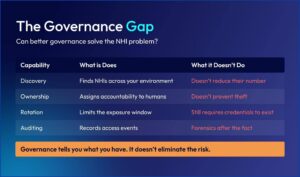
The transformation required is a shift from secret-possession to identity-driven policy. Traditional credentials operate on bearer-token semantics: if you possess the secret, you have access. Dynamic ephemeral credentials invert this model. Identity becomes the foundation — a workload or agent proves who it is, a policy engine determines what it should be allowed to do, and only then is a short-lived credential issued to enable that specific access. The ephemeral credential is not the source of authorization; it is merely the mechanism that carries it.

Dynamic ephemeral credentials represent the gold standard for implementing this identity-driven model, and should guide every machine and AI agent identity decision. They’re not just incrementally better than static credentials—they eliminate entire categories of vulnerabilities and operational complexity. Understanding what makes them superior, how they work in practice, and how to adopt them strategically can transform your organization’s security posture while simultaneously reducing operational burden.
What Makes Dynamic Ephemeral Credentials the Gold Standard?
Dynamic ephemeral credentials fundamentally differ from traditional static credentials in 4 ways, eliminating long-standing security and operational challenges.
Defining Characteristics
Automatic issuance without manual distribution. Unlike API keys that must be generated, stored, and distributed to applications, ephemeral credentials are issued automatically when workloads start (or when an AI agent spins up an ephemeral execution context). No human intervention, no secrets to email or store in configuration management systems.
Short lifespan measured in minutes to hours. Traditional credentials persist for months or years. Ephemeral credentials expire quickly—typically within one to twelve hours—and are automatically renewed as long as the workload remains valid. This temporal limit dramatically constrains the window of opportunity for attackers. The same applies to AI agents: each agent invocation gets only a brief, task‑scoped credential that expires as soon as the agent stops or completes its action.
Just-in-time provisioning. Credentials exist only when needed. When a workload starts (or when an AI agent initiates a tool call), it receives credentials. When it terminates, those credentials become immediately invalid. No credentials sit dormant in configuration files waiting to be discovered.
Cryptographically verifiable identity. Each credential provides unforgeable proof of the workload’s identity using standard formats like X.509 certificates or JSON Web Tokens (JWT). This enables strong authentication without shared secrets.
Why This is Fundamentally Superior
The advantages extend far beyond incremental security improvements:
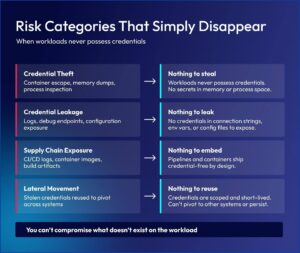
Eliminating entire vulnerability classes. With ephemeral credentials, there are no long-lived secrets to steal from code repositories, no API keys to extract from container images, no passwords stored in configuration files. The credentials that pose the greatest risk in traditional architectures simply don’t exist. This applies especially to AI agents, whose code and prompts may be logged or inspected by frameworks, making embedded secrets particularly dangerous.
Dramatically reduced attack surface. Credentials can be delivered to the actual processes without storing or projecting them on the file system. That makes it very hard for an attacker to compromise a workload and extract its credentials. Credentials can be cryptographically bound to the workload, enabling “proof of ..,possession” which makes it impossible for them to be used outside their intended context. Also, when credentials expire within a short time period (minutes/hours), they shrink any exploitation window from months or years to minutes or hours.
Operational burden eliminated. No more rotation schedules coordinating updates across multiple services and environments. No emergency procedures when credentials leak. No tracking of which applications use which API keys. The system handles credential lifecycle automatically.
True least privilege becomes practical. Each workload receives credentials tailored to its specific needs rather than sharing overprivileged service accounts across multiple applications. This is especially important for agentic AI, where it’s not always clear how much permission an agent will ultimately require to finish a job. When permissions need adjustment, they’re modified for individual workloads without affecting others.
Comprehensive audit trails emerge naturally. Every credential issuance, every authentication event, and every access decision is logged automatically with detailed context about attribution: which workload requested access and what permissions were granted. Investigation becomes straightforward rather than requiring detective work to untangle shared credentials.
The Technical Foundation
Certain dynamic ephemeral credential approaches elegantly solve what security professionals call the “credential bootstrap problem”—the chicken-and-egg challenge of how a workload gets its first credential securely. The breakthrough insight: your infrastructure often already knows where workloads are running and how they got there, and this knowledge can be leveraged to establish trust without distributing secrets.
When a container starts in Kubernetes, the platform knows which service account it’s using, which namespace it’s in, and which node it’s running on. When a Lambda function executes, AWS knows exactly which role it’s assuming. When a virtual machine boots in Azure, the cloud platform can verify its identity through platform-specific mechanisms. Similarly, agentic AI platforms can attest the identity of an AI agent instance by binding credentials to execution context — such as the task ID, calling user, or isolated runtime — ensuring that agents cannot exfiltrate or reuse credentials outside their assigned scope.
Platform attestation leverages this existing knowledge. Instead of distributing secrets beforehand, systems that support attestation verify workload identity using platform-provided information that can’t be easily spoofed—instance metadata, pod specifications, process context, and cryptographic signatures. Once verified, the workload receives a cryptographically signed credential proving its identity. This attestation-based approach solves the bootstrap problem by eliminating the need for pre-distributed secrets entirely.
Process attestation complements platform attestation by verifying what is running, not just where. While platform attestation confirms a workload is executing on an expected node or in an expected namespace, process attestation examines properties of the process itself — its binary hash, code-signing identity, kernel namespace, user/group context, or SELinux label.
Combining both layers ensures that even if an attacker gains access to an attested platform, they cannot impersonate a legitimate workload unless their process matches the expected properties. For AI agents, process attestation can verify the agent runtime, framework version, or plugin signature — ensuring only sanctioned agent code receives credentials.
Several implementation patterns have emerged as standards:
Token-based credentials using OAuth 2.0, JWT, and OpenID Connect provide flexible, widely-supported authentication. The OAuth ecosystem offers mature libraries, well-understood security properties, and broad compatibility with APIs and services.
Certificate-based credentials using X.509 certificates and mutual TLS (mTLS) provide strong cryptographic identity. Technologies like SPIFFE (Secure Production Identity Framework for Everyone) provide a universal standard for bootstrapping workload identity without pre-distributed secrets. SPIFFE can issue both X.509 certificates and JWTs, enabling workloads to prove their identity cryptographically across platforms and organizational boundaries.
Platform-managed identities built into cloud providers—AWS IAM Roles for EC2/ECS/Lambda, Azure Managed Identity, Google Cloud Service Accounts, Oracle Cloud Infrastructure Instance Principals—provide automatic credential provisioning without additional infrastructure. These services leverage the platform’s existing knowledge about your workloads.
Dynamic secret generation from secrets management tools can create ephemeral database credentials, API tokens, or certificates on-demand. While this provides short-lived credentials, it still requires solving the bootstrap problem of authenticating to the secrets manager itself—though once solved, the secrets manager can issue truly ephemeral credentials for downstream systems.
The lifecycle of an ephemeral credential follows a simple pattern: workload starts and requests identity, platform verifies and issues short-lived credential, workload uses credential to authenticate to target systems, credential expires and is automatically renewed if the workload remains valid, and when the workload terminates, the credential becomes permanently invalid.
The Gold Standard in Practice: What Success Looks Like
Understanding the theoretical advantages matters less than seeing how dynamic ephemeral credentials work in real environments and deliver measurable benefits.
Real-World Implementation Patterns
Cloud-native environments achieve the most elegant implementations by combining multiple technologies. A Kubernetes cluster running SPIFFE for workload identity, integrated with a service mesh like Istio or Linkerd for automatic service-to-service authentication, creates an environment where no application needs to manage credentials. Services authenticate to each other using automatically-issued certificates, and the mesh handles encryption and policy enforcement transparently.
Single-cloud deployments can leverage platform-managed identities with minimal additional infrastructure. An AWS application uses IAM roles to access S3 buckets, RDS databases, and other AWS services without storing any credentials. Azure applications use system-assigned managed identities to authenticate with Key Vault, Storage Accounts, and Azure SQL. Google Cloud applications use service accounts with automatic credential provisioning. Oracle Cloud Infrastructure applications use Instance Principals to access OCI services. The platform provides everything needed.
Multi-cloud scenarios benefit from workload identity federation, allowing identities from one platform to be trusted by another—for example, enabling a Kubernetes workload to authenticate to cloud services without storing cloud credentials. In addition, universal identity frameworks like SPIFFE work consistently across AWS, Azure, GCP, on-premises data centers, and edge environments. A workload receives a SPIFFE identity that proves who it is regardless of where it runs, enabling authentication across organizational and platform boundaries.
These approaches complement each other: SPIFFE provides the universal identity standard, while workload identity federation creates trust relationships between different identity systems.
Hybrid approaches bridge the gap during migration. Service meshes can wrap legacy applications, creating a secure perimeter where modern and traditional systems coexist. A legacy application continues using its existing authentication while the mesh handles modern identity and encryption for external communication. This pattern enables progressive modernization without requiring simultaneous changes across the entire estate.
Agentic AI environments increasingly involve agents performing autonomous actions across APIs, cloud resources, and internal systems. Using ephemeral credentials ensures that agents never receive long‑lived secrets and that credentials are bound to agent identity, task context, and user intent. Additionally, every agent action is fully attributable, and even if an agent credential were to be stolen, it is minimally scoped and expires quickly.Measurable Benefits
Organizations implementing dynamic ephemeral credentials report significant improvements across multiple dimensions:
Security posture strengthens dramatically. The 2024 breaches affecting Cloudflare, The New York Times, and Adobe Commerce all stemmed from compromised static credentials—API keys, personal access tokens, and cryptographic keys that persisted longer than they should have. With ephemeral credentials, these attack vectors disappear. Even sophisticated attackers find their stolen credentials expire before they can establish persistence.
Operational overhead vanishes. Teams no longer coordinate credential rotation schedules across development, staging, and production environments. No emergency procedures for managing botched rotations that cause service failures. The platform handles the entire credential lifecycle automatically. Organizations report redirecting hundreds of hours previously spent on credential management toward value-adding security initiatives.
Audit trails become crystal clear. When investigating security incidents or compliance questions, every authentication event is logged with detailed context. Instead of seeing “service_account_prod accessed database” with no way to determine which of twenty applications used that shared credential, logs show exactly which workload, running where, accessed what resource, and what permissions were granted.
Compliance obligations become easier to satisfy. Standards like SOC 2, ISO 27001, and the European NIS2 Directive require strict identity controls, regular credential rotation, and comprehensive audit logging. In the Asia-Pacific region, frameworks such as Japan’s Act on the Protection of Personal Information (APPI) and Singapore’s Cybersecurity Act impose similar requirements on identity and access management. Ephemeral credentials provide these capabilities automatically rather than requiring extensive manual processes and documentation.
Case Studies: Real Organizations, Real Results
Uber: Workload Authentication Across 10,000+ Nodes6
Uber deployed SPIFFE/SPIRE to handle workload authentication across their massive, diverse deployment environment, scaling to over 10,000 nodes. The implementation enables secure service-to-service communication across their ride-sharing platform, managing identities for driver-passenger matching services, payment processing, and location tracking components. Uber’s engineering team contributed multiple improvements back to the upstream SPIFFE/SPIRE projects to better support high availability and simplify onboarding, demonstrating the production-readiness of ephemeral credential architectures at massive scale.
Square (Block): Migrating from 10 Years of Homegrown Service Identity7
Square migrated from a decade-old homegrown service identity system to SPIFFE/SPIRE to secure their payment processing infrastructure. The transition enabled the company to leverage platform-agnostic identity that works across Kubernetes, AWS, GCP, and other environments, providing short-lived certificates, additional security checks when issuing credentials, and better separation between production and staging environments. The framework enables secure identity verification between different components of their payment system, protecting sensitive financial transactions while reducing the operational complexity of managing their hybrid multi-cloud architecture.
Anthem: Building Zero Trust for Healthcare8
Anthem partnered with HPE and open-source communities to develop a zero trust network security model using SPIFFE and SPIRE as the cryptographic, platform-agnostic identity foundation for their Health OS platform. The implementation secures services across heterogeneous environments and organizational boundaries, enabling dozens of smaller networks and applications to communicate securely while protecting member safety, security, and privacy. The framework supports everything from cloud-native applications to 50-year-old legacy assets, providing consistent zero trust security across Anthem’s diverse infrastructure while enabling rapid deployment of scalable applications that improve healthcare outcomes for millions of members.
The Path Forward
Dynamic ephemeral credentials represent more than an incremental improvement in machine identity management—they fundamentally transform how organizations approach workload authentication. By eliminating long-lived secrets, automating credential lifecycle management, and providing cryptographic proof of identity, ephemeral credentials address security vulnerabilities that have plagued organizations for decades. This transformation applies equally to agentic AI systems, where ephemeral, context‑bound identities are essential to prevent uncontrolled autonomy, data leakage, and credential misuse.
The evidence is clear: organizations implementing ephemeral credentials see dramatic reductions in security incidents, operational overhead, and compliance complexity. The real-world implementations at Netflix, Deutsche Bank, and many other organizations demonstrate that this approach works at scale across diverse environments.
The question is no longer whether to adopt ephemeral credentials, but how to begin the transition. While the gold standard is clear, the path to implementation requires careful planning, strategic choices, and organizational alignment.
For a detailed roadmap on implementing dynamic ephemeral credentials in your organization, including practical adoption strategies, implementation patterns, and guidance on overcoming common obstacles, see the companion document: “Implementing the Gold Standard: A Roadmap for Dynamic Ephemeral Credentials.”
Felix Gaehtgens the VP, Product Strategy for member company BeyondTrust, and is an active member of the IDSA Machine and Agentic Identity Working Group. To learn more about membership and participating in the working group, email member@idsalliance.org.
To learn even more, be sure to register for and attend our working group webinar coming in July 2026. You can sign up at idsalliance.org.
References
- GitGuardian – State of Secrets Sprawl 2025 Report. Retrieved from https://blog.gitguardian.com/the-state-of-secrets-sprawl-2025/
- IBM Cost of a Data Breach Report 2025. Retrieved from https://www.ibm.com/think/topics/data-breach
- Cloudflare Suffers Breach After Failing to Rotate Stolen Okta Credentials by James Coker, Infosecurity Magazine 2024. Retrieved from https://www.infosecurity-magazine.com/news/cloudflare-breach-stolen-okta/
- How a mistakenly published password exposed Mercedes-Benz source code by Carly Page, Techcrunch 2024. Retrieved from https://techcrunch.com/2024/01/26/mercedez-benz-token-exposed-source-code-github/
- Thousands of Adobe Commerce stores hacked in competing CosmicSting campaigns by the Sansec Forensics Team 2024. Retrieved from https://sansec.io/research/cosmicsting-fallout
- Moore, A. (2020). Uber’s Findings on Observability in SPIRE at Scale. SPIFFE Community Day. Retrieved from https://spiffe.io/docs/latest/spiffe-about/community-presentations/
- Byczkowski, M. (2020). 10 Lessons From Migrating to SPIFFE After 10 Years Of Service Identity at Square. SPIFFE Production Identity Day, KubeCon NA 2020. Retrieved from https://spiffe.io/docs/latest/spire-about/case-studies/
- Upshot Stories. (2021, May 10). Developing a Zero Trust Framework at Anthem Using SPIFFE and SPIRE. Retrieved from https://upshotstories.com/stories/developing-a-zero-trust-framework-at-anthem-using-spiffe-and-spire